
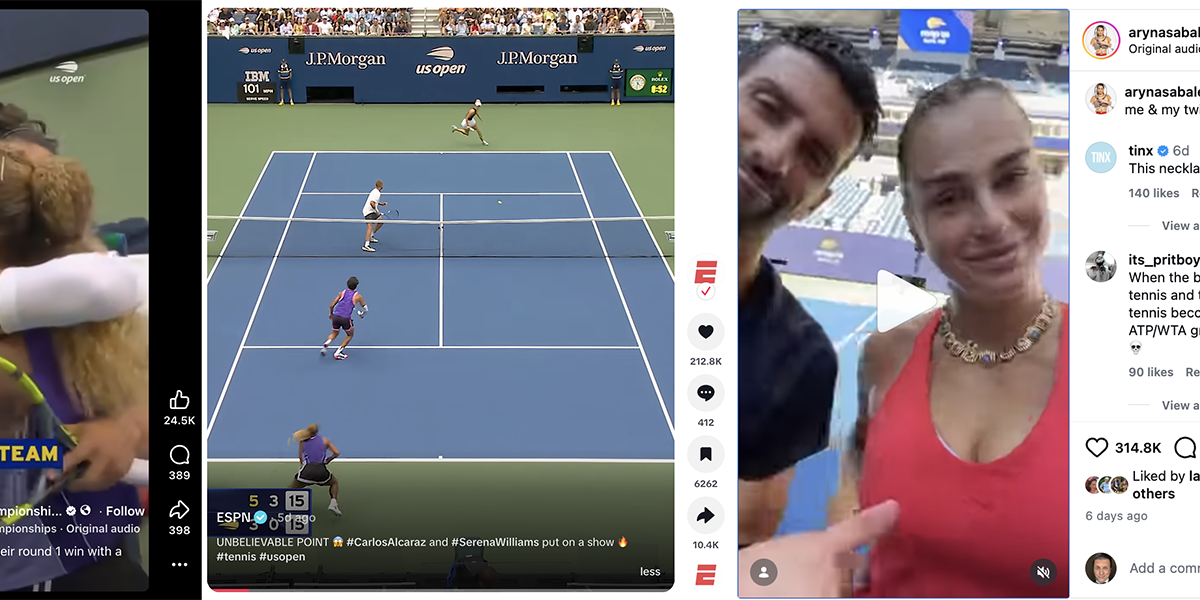
The US Open is always one of the most electric events on the sports media calendar. But this year, as the world’s top athletes converged in New York, the single biggest trend dominating social feeds wasn't solo highlights or tournament match points, it was unexpected collaborations between men’s and women's tennis stars.
Collabing with an adjacent audience is one of the oldest plays in the social playbook. But at this year's tournament, the multiplier was unprecedented. According to data from MondoTrends’ Content Intelligence, unexpected tennis pairings generated a massive +62% engagement lift over baseline, proving that crossover moments are outperforming standard solo coverage across every major platform.
Here is a look at how the "Unexpected Collab" trend unfolded across the US Open, and how brand and social teams can build a strategy around it.
On the Court: Media Coverage Delivers on Mixed Doubles Excitement
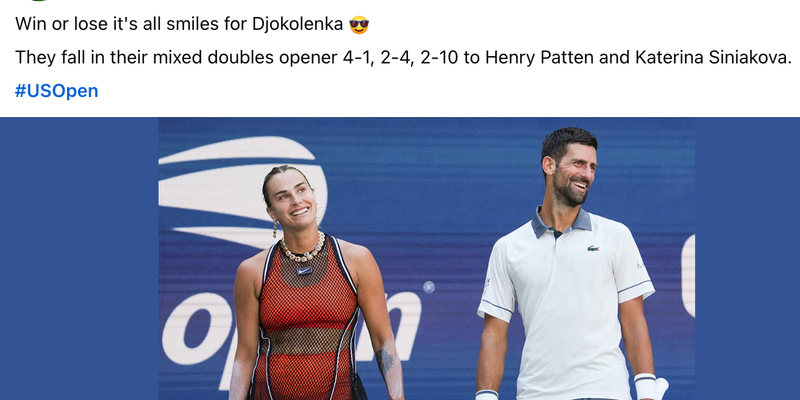
Mixed doubles has historically lived on the undercard of casual media coverage. This year, it was prime-time social real estate. The reaction content and pre match buzz around Serena Williams with Carlos Alcaraz, Novak Djokovic with Aryna Sabalenka, and Taylor Fritz with Elena Rybakina, was just as successful as the match content themselves.
Even simple practice session interactions, like Mirra Andreeva and Andrey Rublev sharing a candid moment, became top-performing content.
Examples
🎵 espn, TikTok — 228.1K eng / 2.0M views — 11.4% engagement rate, vs. a 6.3% median across the list "This UNBELIEVABLE POINT 😱 #CarlosAlcaraz and #SerenaWilliams put on a show 🔥 #tennis #usopen" Watch the post
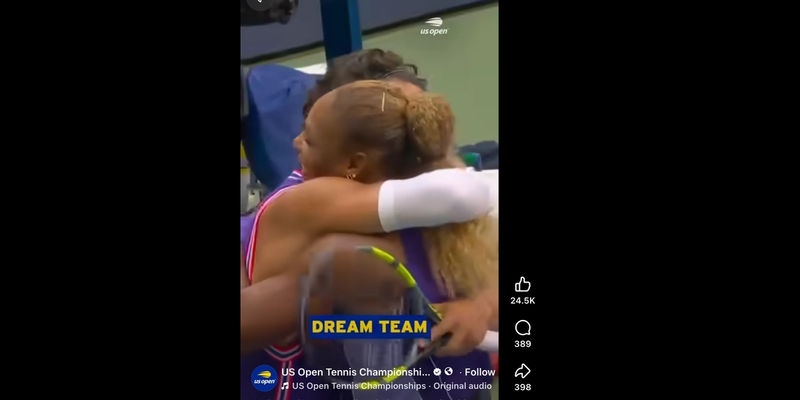
📘 usopentennis, Facebook — 24.8K eng — 1.63× the account's average "Carlos and Serena sealing their round 1 win with a hug!" View the post
📘 ATPTour, Facebook — 17.2K eng — 2.38× the account's average "This duo 🙌" View the post
📘 tennischannel, Facebook — 10.8K eng — 1.68× the account's average "Win or lose it's all smiles for Djokolenka 😎" View the post
📷 tennischannel, Instagram — 93.3K eng / 6.8M views (as of this writing) — 3.3% engagement rate. "All smiles ahead of the mixed dubs championship 😆🫶 #usopen" — Mirra Andreeva and Andrey Rublev at the practice courts ahead of their mixed doubles run; tennischannel's top post of the week. https://www.tiktok.com/@tennischannel/video/7678471257876073758
Try this: If your sport has any format that naturally pairs athletes across gender lines, mixed doubles, mixed relays, co-ed events, stop treating it as a lower-tier bracket to under-cover. Program it deliberately, and don't hold the coverage back. It's functionally a pre-built crossover post, and right now it's converting better than the format ever has in the past.
Off the Court: Player Handles & Cross-Sport Synergies
The power of an unexpected collab doesn't stop when players walk off the court. Some of the week’s highest-performing content came directly from the players' personal accounts, leaning into unscripted warmth, mutual admiration, and shared cultural identity.
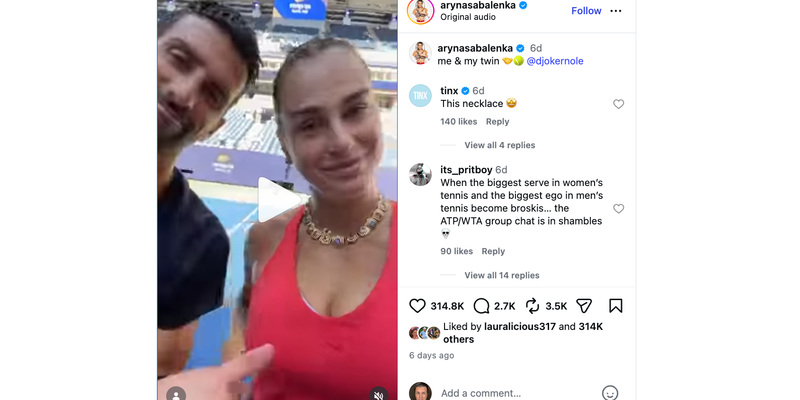
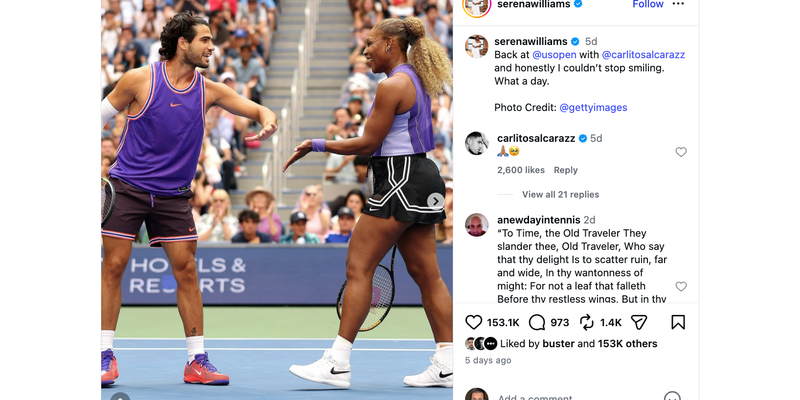
Sabalenka captioning a photo with Djokovic as "me & my twin" tapped into personable, candid star power. Meanwhile, Alcaraz and Williams’ mutual posts on Instagram drove massive engagement by giving fans an intimate look at two legends sharing a stage and their mutual admiration.
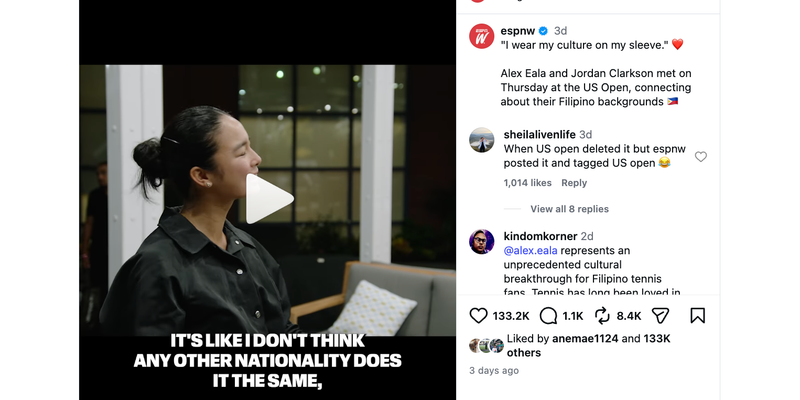
Crucially, this mechanic generalizes beyond tennis. One of the week's standout posts paired Filipino tennis sensation Alex Eala with Filipino NBA guard Jordan Clarkson, connecting on their shared heritage rather than a shared sport.
Examples
📷 arynasabalenka, Instagram — 313.2K eng — 1.75× the account's average "me & my twin 🤝🎾 @djokernole" View the post
📷 serenawilliams, Instagram — 150.3K eng "Back at @usopen with @carlitosalcarazz and honestly I couldn't stop smiling. What a day." View the post
📷 carlitosalcarazz, Instagram — 536.6K eng "It was a real honor to play with you Serena! 🐐 @serenawilliams" View the post
📷 Instagram — 133.2K eng — 1.56× the account's average "'I wear my culture on my sleeve.' ❤️ Alex Eala and Jordan Clarkson met on Thursday at the US Open, connecting about their Filipino backgrounds 🇵🇭" View the post
Why the Collab Multiplier Hits Differently Right Now
Cross-audience collabs are traditionally a simple audience exchange: borrowing someone else’s followers for the cost of a joint post. What’s changed is which side of the trade is appreciating.
Women's sports fandom, in tennis, the WNBA, soccer, and beyond, is surging in reach and cultural volume faster than traditional sports media has fully priced in. When an established men's sports star or mainstream brand collaborates with a women's sports star, it’s not a 50/50 split of two static audiences. It’s a stable audience intersecting with one that is actively expanding. The post gets carried in both directions at once.
The Playbook: How Content Teams Can Leverage the Trend
Unexpected crossover content shouldn't be a happy accident—it should be a prioritized production strategy.
- Don't Under-Cover Co-Ed Formats: If your sport features mixed doubles, mixed relays, or co-ed exhibition events, stop treating them as lower-tier coverage. Program them deliberately—they are pre-built viral engines.
- Audit Natural Overlaps: Map out upcoming events for points where your athletes’ paths naturally cross with stars from other leagues or sports—whether through shared sponsors, hometowns, heritage, or joint appearances.
- Build Lightweight Capture Plans: You don't need to over-produce or manufacture the moment. You just need a social capture plan in place so your team doesn't miss the candid hallway interaction or joint practice session when it happens.
- Integrate Sponsors: Pairing two superstars in a sponsored post might seem like an expensive gambit, but the engagement multiplier makes it one of the most cost-effective activations on the board. When you leverage shared brand rosters (e.g., two athletes under the same Nike, Red Bull, or Gatorade umbrella), you turn single-athlete deals into a unified campaign..
Methodology: trend-level lift figures are drawn from MondoTrends' Intelligence cross-platform Women’s Sports Index (Aug 25– Aug 31), based on data through the tournament's first week. Individual post engagement figures and "X× average" multipliers are pulled from the public post data of the accounts shown as of this writing and will continue to climb as the tournament progresses.