
Since August 24, everyone who buys or sells YouTube has been asking me the same question: do we sell on engaged views or public views? Podcasting answered first. Within a month, Podtrac switched its rankings to engaged views and three leading podcast ad agencies said they'd only buy on them.
Quick background. YouTube changed the definition of a view. A public view now counts the moment a video starts playing, from the very first frame. The old, stricter definition was renamed "engaged views" and moved into YouTube Analytics, where only the channel owner can see it. YouTube still pays creators on engaged views.
Before you pick a currency, you need to know how far apart the two numbers are, so we measured it in MondoTrends: 1,139 channels, more than 209,000 long-form videos and 12.9 billion public views. Public views now run about 1.82x the old count on long-form. The gap is narrowest for podcasts and widest for short clips, small channels, and sports and media.
So here's my answer. The podcast agencies made the right call for podcasts. But what's right for podcasts isn't right for all of YouTube. The right number depends on where the sponsor's message sits.
How far apart the two numbers are
We compared 1,139 YouTube channels against themselves. For each one, we took the median views on long-form videos posted in the 8 weeks before August 24 and the 8 weeks after. Measuring every channel against its own baseline matters here. Otherwise a handful of giant channels would decide the answer for everyone.
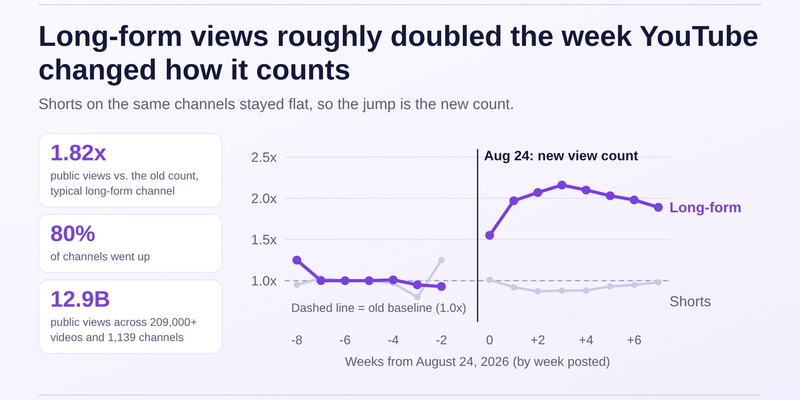
That's 70,306 videos and 3.4 billion public views before the change, and 138,703 videos and 9.5 billion public views after. I left Shorts out of the headline. Shorts switched to first-play counting back in March 2025, so this change mostly lands on long-form.
And these aren't random channels. This is the universe our clients in sports, media and entertainment actually buy, sell and benchmark against: pro teams and leagues, broadcasters and publishers, the biggest podcasts on the platform and top creators.
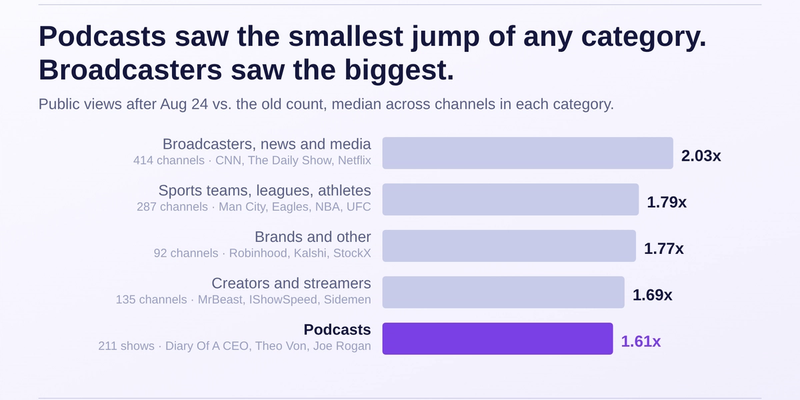
Alt text: Lift by category. Broadcasters 2.03x, sports 1.79x, brands 1.77x, creators 1.69x, podcasts 1.61x
Broadcasters and publishers got the biggest jump. Podcasts and top creators got the smallest, which tracks with everything else in the data: longer videos and bigger audiences inflate less.
The gap opened the week the count changed
Long-form views sat right at baseline for the seven weeks before August 24. Then they roughly doubled and stayed there. Shorts on the same channels didn't move over the same weeks, which rules out football season or audience growth. This is the new count, full stop.
Our numbers line up with what creators see in their own analytics. Agentio looked at 75,000+ videos and found public views run about 1.67x engaged views. We measured 1.82x from the public side, on a set of channels that skews toward smaller accounts, which is exactly where you'd expect the gap to be bigger.
The gap isn't the same for everyone
The new count doesn't lift everyone equally, and this is the part I'd pay the most attention to. Small channels more than doubled. The biggest channels rose by less than half. Video length tells the same story. Clips under 3 minutes inflated the most, and anything 30 minutes or longer inflated the least.
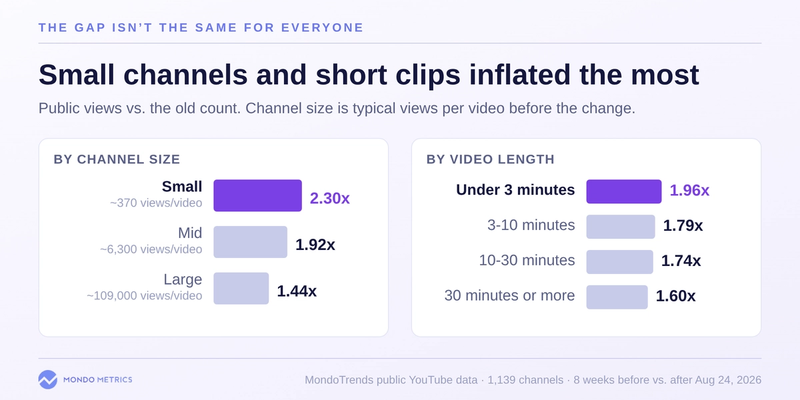
Alt text: Small channels 2.30x, mid 1.92x, large 1.44x. Under 3 minutes 1.96x, 3-10 minutes 1.79x, 10-30 minutes 1.74x, 30 minutes or more 1.60x
My read: the new count picks up autoplays, feed previews and quick skims that never would have cleared the old bar. That kind of passive play is a bigger share of a small channel's audience, and a bigger share of short clips. Big channels and long episodes have more people who showed up on purpose.
That matters for anyone ranking channels. On public views, small channels and short clips now look better against bigger channels and longer formats than they did in July. If you benchmark YouTube, you need to know which side of August 24 your numbers came from.
Podcasts are the easy case
Podcasts got the smallest bump of any category we track: 1.61x across 211 shows, more than 13,000 videos and 2.7 billion public views. That's why engaged views fit podcasting so well. People who press play on a 90-minute episode mostly meant to. The ad sits inside the content, so a first-frame play is worth nothing to a host-read sponsor. And podcasting already buys on a stricter number: a download only counts after 60 seconds.
Our numbers line up almost exactly with Podtrac, which pulled engaged views straight from YouTube's API across 84.2 million podcast views in late August. We measured from the public side, they measured from the private side, and we landed in the same place.
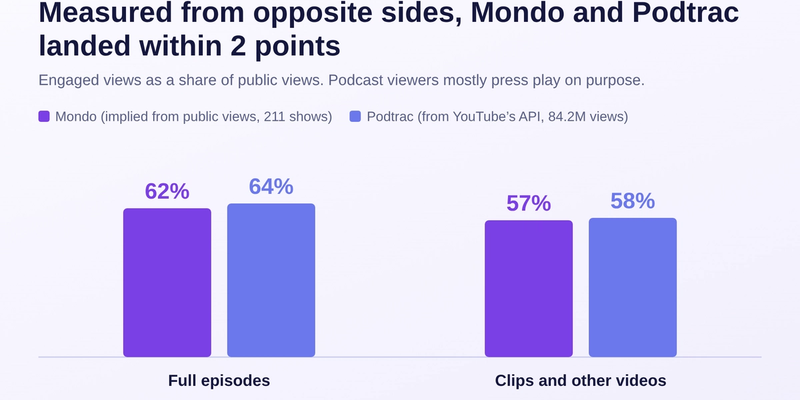
Alt text: Engaged share of views. Full episodes: Mondo 62%, Podtrac 64%. Clips: Mondo 57%, Podtrac 58%
The size gap shows up here too. Small shows jumped 2.13x, while the biggest shows rose 1.35x. If you're comparing a mid-size show's YouTube numbers against a top-10 show, the new count flatters the smaller one.
Who else is weighing in
The podcast industry moved fast on this. Here's where the conversation stands:
- The agencies picked engaged views - At the Sounds Profitable Business Summit in September, ADOPTER Media, Right Side Up and Oxford Road said they'll only count YouTube engaged views when buying ads, and YMH Studios said the same (Podnews). Oxford Road's Dan Granger said the industry should "get a little fed up" and make its voice heard. YouTube gave five business days' notice before the change.
- Podtrac switched its rankings - Podtrac now ranks YouTube podcasts on engaged views, not the public count (Podtrac).
- Engaged views are a black box - Podnews points out that YouTube has never disclosed how engaged views are calculated, and that the count is now private: it's gone from public pages and the public API (Podnews).
- Name the metric in the contract - Forbes' advice to marketers: treat August 24 as a break in the series, and spell out in every brief and deal whether "views" means public or engaged (Forbes).
There's also no industry standard to fall back on. The IAB defines a video play as 50% of the pixels on screen for two seconds, and a podcast download as 60 seconds of content transferred to a device (Podnews). Neither one is a YouTube public view or a YouTube engaged view.
Clips and highlights are a different business
Sports and media are the opposite case. Broadcasters jumped 2.03x and clips under 3 minutes jumped 1.96x, the biggest gaps in our data. On a podcast, that gap would be a problem. On a highlight, it mostly isn't.
- The message is on screen from the first frame - A sponsor bug, a branded segment or a logo on the field delivers exposure the moment the video plays. That's an impression, and impressions are what sponsorship valuation runs on.
- Every other platform counts the same way - TikTok, Reels and Facebook all count a view when the video starts. A team that switched YouTube alone to engaged views would undercount YouTube against every other platform in its sponsor reporting. Public views keep YouTube apples to apples.
Creator integrations need a third number
A 60-second integration at the 4-minute mark only reaches people still watching at minute 4. Engaged views overstate that audience too. The honest number is retention at the integration's timestamp, and only the creator can pull it.
Match the number to where the message sits
That's the real answer to the question. It isn't engaged versus public. It's which number matches where the ad sits.
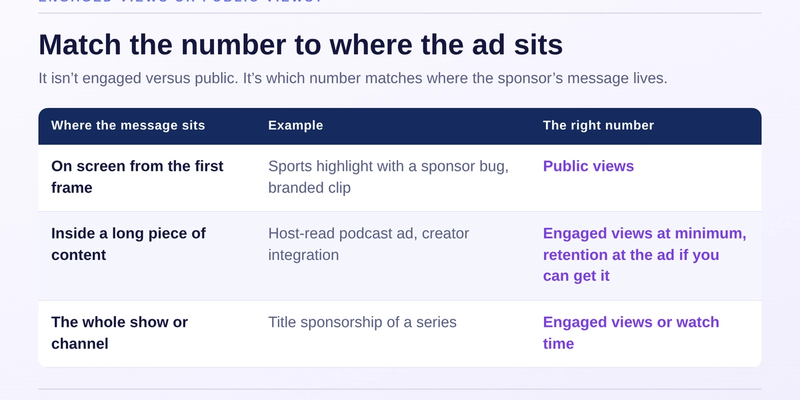
Alt text: On screen from the first frame: public views. Inside a long piece of content: engaged views at minimum, retention at the ad if you can get it. The whole show or channel: engaged views or watch time
What each number is good for
The two numbers do different jobs. One measures reach, the other measures attention.
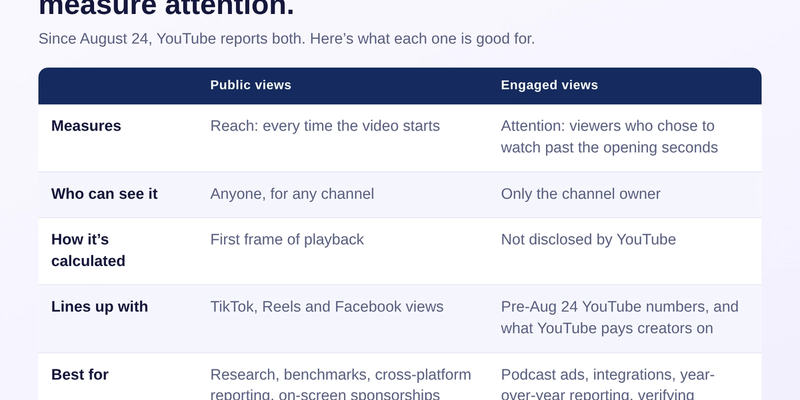
One more thing on public views: nobody is going to cut their CPM, so anyone selling on public views just got about 80% more inventory from the same audience. Buyers don't lose out if they adjust. Keep buying on CPM and ask partners to raise the view commitment to match the new count.
Four ways to sell it
Once you know which number fits, there are four workable ways to structure the deal:
- Sell on public views, raise the commitment - Keep the CPM and raise the view guarantee to match the new count. This works when both sides want a number anyone can see and verify. Buyers measuring cost per result still need to know the engaged rate.
- Sell on engaged views, keep the old CPM - Price and guarantee on engaged views, so pre-change deals carry over. This works for renewing deals priced before August 24. Only the channel owner sees engaged views, so delivery depends on their screenshots or analytics access.
- Sell on public views at an adjusted CPM - Lower the CPM by the channel's engaged view rate, so the price of real attention stays the same. This works for new deals where the buyer wants public numbers but last year's economics. Each channel's rate is different, so one blanket discount won't fit everyone.
- Sell on one, report both - Price on either number, and report public views, engaged views and the ratio between them. This works for long-term partners who want the full picture. It means more reporting work every campaign.
Whichever option you pick, convert with the channel's own engaged view rate: engaged views divided by public views, straight from YouTube Analytics. In our data the typical long-form channel lands around 55%, and Agentio's creator data puts it near 60%. But the middle half of channels runs anywhere from 1.19x to 2.94x, so a blanket 1.8x adjustment will overpay for some shows and underpay for others. Use the channel's real number, not an average.
My take
Here's where I land. The podcast agencies made the right call for podcasts, and anyone selling host-read ads should expect to settle on engaged views. But exporting that standard to all of YouTube would be a mistake. Sports highlights and branded clips deliver from the first frame, and every platform they're reported against counts the same way.
The bigger risk is accountability. Public views are the only YouTube number a brand can look up for any channel, compare across creators and track over time. Move everything to engaged views and brands lose the ability to do their own research. Big agencies can make engaged-view access a condition of buying. Smaller brands can't, so they end up shortlisting and verifying with numbers the seller hands them.
So here's my split. Research on public views, where benchmarks hold up well: Podtrac and we landed within a few points of each other measuring from opposite sides. Settle the deal on the number that matches where the ad sits. And verify every individual deal, because at the channel level the gap is too wide to guess.
The view isn't going away as a currency. It just stopped being one number. The teams that come out ahead will be the ones who know which number fits the deal in front of them.
Methodology
- Source: MondoTrends public YouTube data, pulled November 5, 2026.
- Windows: 8 weeks before (videos posted June 29 - August 23, 2026) and 8 weeks after (August 24 - October 18, 2026).
- Videos: long-form only. Shorts and live streams are excluded.
- Channels: the 1,139 channels with at least one long-form video in each window.
- Scale: 209,009 long-form videos (70,306 before, 138,703 after) and 12.9 billion public views. Podcasts: 13,279 videos and 2.7 billion public views.
- Categories: assigned from the MondoTrends lists each channel belongs to. A channel on several lists is counted once, in the first matching category: podcasts, then sports, creators, media, and brands and other.
- Podcasts: full episodes are videos 20 minutes or longer; clips are under 20 minutes. Implied engaged share = 1 divided by the lift.
- Metric: each channel's median views per video after, divided by its median before. The headline is the median across channels.
- Timing: view counts were taken 7-45 days after posting on both sides (median 31 days before, 25 days after), so videos are compared at a similar age. Before-period counts were all recorded before August 24.
- Reference: Shorts on the same channels held flat over the same weeks (0.95x), so the long-form jump isn't a seasonal or audience-growth effect.
- Robustness: the result holds between 1.74x and 1.82x across different video-age cutoffs.
Sources: YouTube Help community announcement · Podnews: YouTube changes how views are calculated · Podnews: Agencies agree to only buy on engaged views · Podtrac YouTube podcast analysis · Forbes · Tech Times · Agentio